New Hampshire Lawmakers Challenge Ayotte's Cannabis Veto Threat
Republican and Democratic legislators say governor's opposition ignores voter will and revenue opportunity.
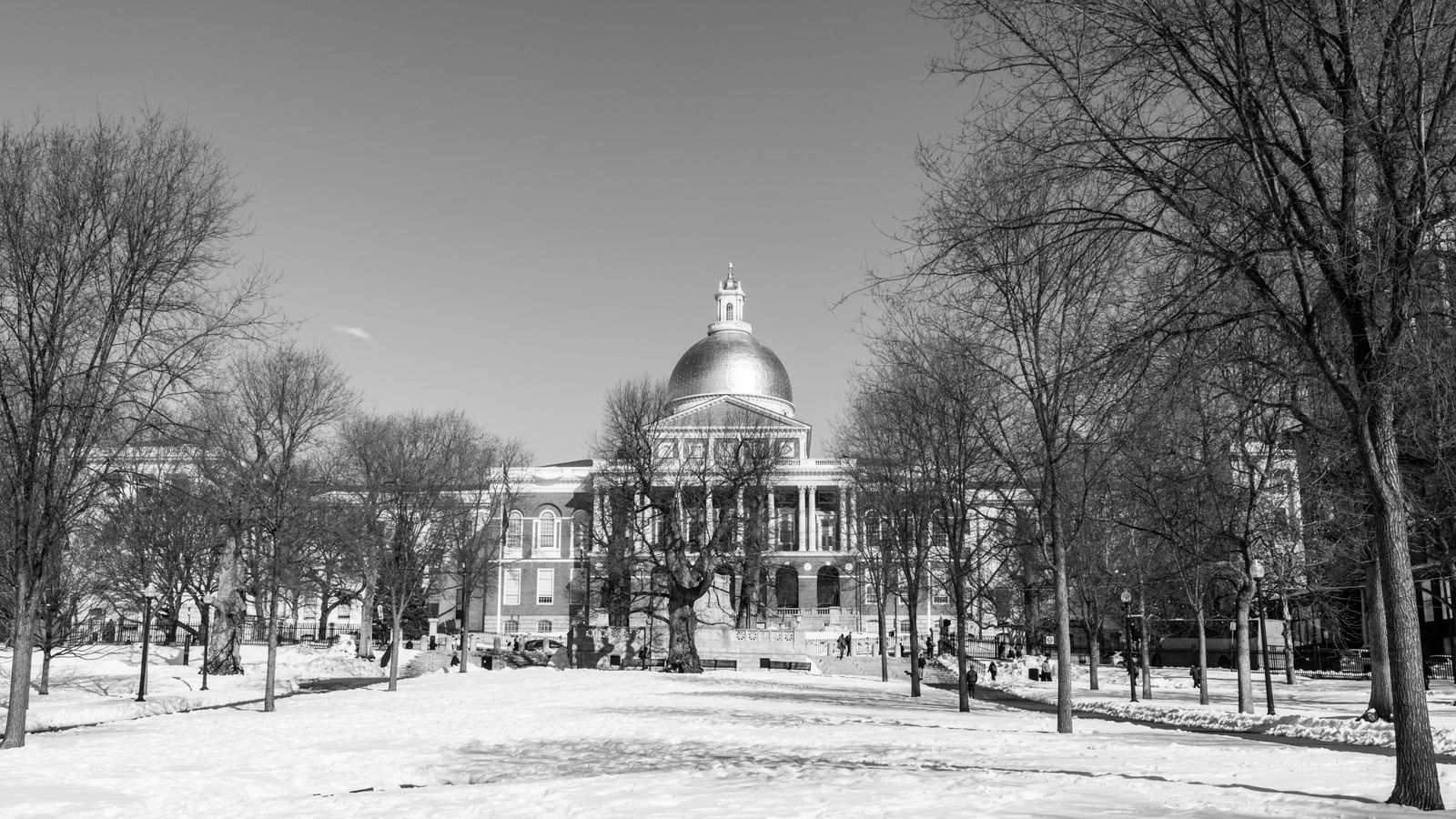
Black and white photo of the Massachusetts State House during winter in Boston.
Bipartisan Coalition Defends Legalization Bill
At least eight state lawmakers—four Republicans and four Democrats—issued public statements Monday defending HB 639, the adult-use cannabis legalization bill Ayotte has threatened to veto. The bill cleared the House 212-163 in June and the Senate 14-10 in July, margins that fall short of the two-thirds supermajority needed to override a gubernatorial veto.
House Majority Leader Jason Osborne (R-Auburn) said Ayotte's position "disregards the economic reality facing our border towns." New Hampshire residents spent an estimated $127 million at Bay State dispensaries in fiscal 2025, according to Massachusetts Department of Revenue data. That generated roughly $25 million in Massachusetts tax revenue.
Senate Minority Leader Donna Soucy (D-Manchester) told reporters the governor "is choosing ideology over pragmatism." She noted that 63% of New Hampshire voters supported legalization in an April 2026 University of New Hampshire poll.
Ayotte Cites Public-Safety Concerns
Ayotte has maintained since her January inauguration that she'll veto any legalization measure, citing concerns about impaired driving and youth access. In a July 18 press conference, the governor said she would "not sign legislation that puts our kids at risk." She pointed to a 2024 study by the New Hampshire Highway Safety Agency showing a 14% increase in THC-positive toxicology results among drivers involved in fatal crashes between 2020 and 2023.
That study didn't establish causation. Legalization advocates note the data predates any New Hampshire retail market. Vermont and Maine, both of which border New Hampshire and have operational adult-use programs, reported no statistically significant change in traffic fatalities per vehicle mile traveled in the three years following legalization, according to National Highway Traffic Safety Administration data.
Revenue Projections Fuel Legislative Push
HB 639 would impose a 10% excise tax on adult-use sales plus the state's 9% rooms-and-meals tax, generating an estimated $31 million to $44 million annually by fiscal year 2028. The Legislative Budget Assistant's fiscal note projects the following revenue ramp:
- FY 2027 (partial year): $8.2 million
- FY 2028: $31.4 million
- FY 2029: $38.7 million
- FY 2030: $44.1 million (steady-state estimate)
Forty percent of excise revenue would go to the Education Trust Fund under the bill. Another 30% would fund substance-abuse treatment programs, 20% would support municipal aid, and 10% would cover regulatory oversight by the New Hampshire Liquor Commission, which would administer the licensing program.
Representative Jerry Knirk (R-Freedom), a co-sponsor, said the allocation formula "addresses every concern the governor has raised" by directing substantial funds to prevention and treatment.
Timeline and Override Math
If the legislature transmits HB 639 to Ayotte's desk by September 15, she has five days to sign, veto, or allow the bill to become law without her signature. A veto would return the bill to the chamber of origin—the House—where a two-thirds vote (267 of 400 members) is required to override. The Senate would then need 16 of 24 votes.
The numbers tell the story. The original House vote of 212-163 represents 56.5% support, well short of the 66.7% threshold. Senate passage at 14-10 translates to 58.3%, also insufficient.
No Republican who voted against the bill in either chamber has publicly signaled a willingness to flip for an override vote. House Speaker Sherman Packard (R-Londonderry), who voted for HB 639, told the Concord Monitor on August 22 that he doesn't expect an override to succeed but will schedule the vote "out of respect for the process."
The math is unforgiving: without at least 55 additional House votes and two more Senate votes, the bill dies on Ayotte's desk.
Comparison to Neighboring States
New Hampshire remains the only New England state without an operational or statutorily authorized adult-use cannabis market. Here's the regional landscape:
- Maine: Retail sales began October 2020; 183 active retail licenses as of August 2026; $15.2 million in excise revenue in Q2 2026.
- Vermont: Retail sales began October 2022; 47 active retail licenses; $4.1 million in excise revenue in Q2 2026.
- Massachusetts: Retail sales began November 2018; 403 active retail licenses; $238 million in excise and sales tax revenue in fiscal 2025.
New Hampshire's population of 1.4 million and its status as a destination shopping state due to no sales tax make it an attractive market. Industry analysts estimate 60-80 retail licenses would be issued in the first two years under HB 639's competitive application process.
Medical Program Remains Separate
New Hampshire's existing therapeutic cannabis program, established in 2013, operates independently and wouldn't be affected by HB 639. The program serves approximately 9,800 registered patients as of July 2026 and is administered by four vertically integrated Alternative Treatment Centers licensed by the Department of Health and Human Services.
HB 639 prohibits the Liquor Commission from issuing adult-use licenses to existing medical operators for the first 18 months, a provision designed to create market access for new entrants. Medical cultivators have lobbied against that restriction, arguing it delays supply chain maturation.
What Happens Next
The legislature reconvenes September 10 for a brief veto session. If Ayotte vetoes HB 639 as expected, the House will vote on an override within 48 hours. Barring a dramatic shift in Republican caucus sentiment, the veto will stand. The bill will die.
Legalization proponents say they'll refile in the 2027 session, which convenes January 7. That timeline would push any potential retail launch to 2028 at the earliest, assuming passage and a 12-18 month licensing and buildout period.
For full background on this story, see the CannIntel topic hub on New Hampshire legalization.
Sources
The cannabis newsletter you forward to your team.
Federal policy, market data, grower alerts, and the one story that matters today. Sent every weekday at 7am. Free.
No spam. Unsubscribe with one click. 21+ only.
Related from Laws

Virginia Hemp Retailers Sue State Over New THC Limits
Lawsuit challenges emergency regulations capping intoxicating cannabinoids at 0.3% total THC per package.

Suffolk Sheriff Tompkins Faces Federal Trial on Cannabis Extortion Charges
Trial begins Monday for Massachusetts sheriff accused of shaking down dispensary applicants for bribes.

Germany's Cannabis Imports Surge 18 Months After Legalization
Import data shows Germany's domestic cultivation lagging as licensed imports climb and policy concerns mount.
More from the newsroom

Curaleaf Launches Takeover Bid for Aurora Cannabis
U.S. MSO Curaleaf initiates acquisition offer for Canadian LP Aurora Cannabis in cross-border consolidation play.
Trulieve Completes NYSE Uplisting as Schedule III Takes Effect
Florida MSO transitions to New York Stock Exchange amid federal rescheduling milestone.

California, Michigan and Florida Lead 2026 State Cannabis Sales
New sales data ranks the top 10 state markets as adult-use expansion reshapes regional dominance.