Michigan Judge Upholds Menominee Dispensary Cap in Zoning Challenge
A circuit court ruled the city's three-dispensary limit is a valid zoning ordinance, not an unlawful quota.
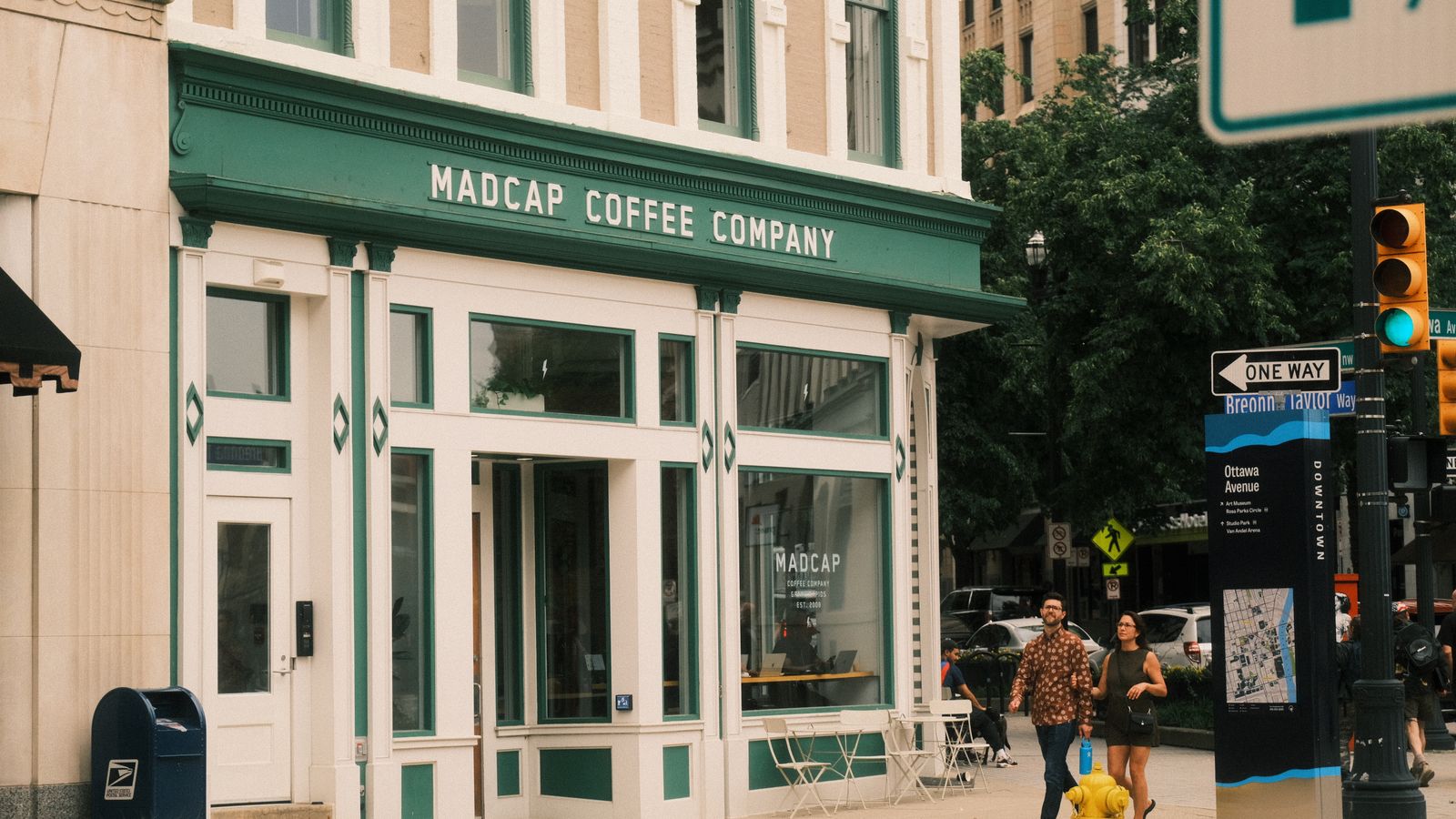
A couple walks past Madcap Coffee Company in downtown Grand Rapids, Michigan.
Court Finds Dispensary Cap Is Zoning, Not Quota
The judge held that Menominee's ordinance regulates location and land use rather than the total number of state licenses, distinguishing it from an unlawful quota. The city's code restricts cannabis retailers to three sites within designated commercial zones. That structure falls within the municipal zoning powers granted under Michigan's Zoning Enabling Act, according to the ruling, and doesn't conflict with the Michigan Regulation and Taxation of Marihuana Act (MRTMA).
The plaintiff—a provisioning center applicant denied a local permit—had argued the three-store ceiling functioned as a de facto quota prohibited by state statute. MRTMA bars municipalities from adopting "unreasonably impracticable" restrictions that have the effect of prohibiting all licensed facilities. The court disagreed. Menominee allows dispensaries by right in specific districts, the judge noted, and the cap applies equally to all applicants through a time-of-application queue.
Menominee sits on the Wisconsin border in the Upper Peninsula. Population: roughly 8,200. City records show three adult-use retailers currently hold local authorization and state licenses.
Implications for Michigan's Patchwork Local-Opt-In Framework
The ruling gives legal cover to at least 12 other small Michigan municipalities that have enacted similar numerical caps, often justified as traffic-mitigation or compatibility measures. Cities including Iron Mountain, Gladstone, and Manistique have adopted ordinances limiting provisioning centers to between two and five locations. Until this decision, operators and attorneys had debated whether such caps survived scrutiny under MRTMA's prohibition on "unreasonably impracticable" barriers.
Michigan's adult-use framework allows cities to opt out entirely or to regulate "the time, place, and manner" of cannabis businesses. More than 1,400 municipalities have opted out. Among the roughly 200 that permit adult-use retail, a minority impose numerical caps; most use only distance buffers and zoning-district restrictions.
Menominee doesn't bind other circuits. But it establishes persuasive precedent. Operators considering litigation in similarly restrictive jurisdictions now face a higher bar.
Operator Strategy in Cap Jurisdictions
In cities with dispensary caps, the first-mover advantage is decisive. Menominee's ordinance awards permits in order of complete-application submission. The three incumbents filed within 48 hours of the ordinance's effective date in late 2022. Subsequent applicants, including the plaintiff in this case, were placed on a waiting list that activates only if an existing permit is surrendered or revoked.
No Menominee permit has turned over since the program launched. The city charges a $5,000 annual local licensing fee in addition to state fees, and each of the three stores reported gross receipts exceeding $2 million in 2025 according to municipal excise records. That revenue concentration creates a strong incentive for incumbents to keep operating.
For operators evaluating new markets, the Menominee ruling underscores the need for speed in jurisdictions signaling cap adoption. Legal challenges are expensive and slow. They now face unfavorable case law in at least one circuit.
Zoning-Power Boundaries Under State Law
The court's reasoning hinges on the distinction between regulating "where" and regulating "how many." Michigan's Zoning Enabling Act grants cities broad authority to divide territory into districts and to prescribe uses within each district. A cap that applies uniformly within a permissible zone is treated as a density regulation, analogous to limits on gas stations or liquor stores.
MRTMA expressly preserves municipal zoning authority but prohibits rules that are "unreasonably impracticable." Courts have interpreted that phrase to invalidate outright bans disguised as zoning and buffer rules so restrictive that no compliant site exists. Menominee's ordinance survived because it designated multiple commercially zoned parcels as eligible and didn't impose distance buffers that eliminated all feasible locations.
The plaintiff didn't appeal as of this writing. The 30-day appeal window closes in mid-August 2026.
What Operators and Municipalities Should Watch
This decision likely accelerates cap adoption in small Michigan cities weighing whether to permit adult-use retail. City councils in communities under 15,000 residents have cited resident opposition and infrastructure concerns when considering caps. Menominee removes legal uncertainty that had deterred some councils from enacting numerical limits.
For operators, the ruling reinforces the strategic value of early local-government engagement. In Michigan's opt-in regime, municipal approval precedes state licensing. Wait for state clarity on local rules and you risk losing access to capped markets. For background on Michigan's local opt-in framework and how caps interact with state licensing queues, see the CannIntel topic hub on Michigan local cannabis zoning.
Next signal: whether any of the 12 cities with similar caps face renewed litigation. Attorneys representing denied applicants in Iron Mountain and Gladstone had indicated they were monitoring the Menominee case before deciding whether to file.
Frequently asked questions
What did the Michigan court rule about Menominee's dispensary cap?
The circuit court held that Menominee's three-dispensary limit is a valid zoning ordinance regulating location and density, not an unlawful quota. The cap applies uniformly within designated commercial zones and does not violate Michigan's adult-use cannabis statute, which bars unreasonably impracticable restrictions.
How many Michigan cities have similar dispensary caps?
At least 12 small Michigan municipalities have enacted numerical caps ranging from two to five dispensaries. These cities, mostly in the Upper Peninsula and northern Lower Peninsula, justify the caps as traffic-mitigation or land-use-compatibility measures under local zoning authority.
Can operators challenge dispensary caps in Michigan?
Operators can challenge caps, but the Menominee ruling sets persuasive precedent that such limits are lawful if they apply uniformly, designate feasible sites, and do not function as de facto prohibition. Legal challenges are expensive and now face unfavorable case law in at least one circuit.
What is the strategic takeaway for operators in cap jurisdictions?
First-mover advantage is critical. Menominee awards permits by application order, and no incumbent has surrendered a license since 2022. Operators must engage early in the local approval process or risk permanent exclusion from capped markets with high per-store revenue.
Does this ruling apply statewide in Michigan?
No. The decision is from one circuit court and does not bind other Michigan circuits. However, it establishes persuasive precedent that other courts and municipalities are likely to cite when evaluating or defending similar caps.
Sources
The cannabis newsletter you forward to your team.
Federal policy, market data, grower alerts, and the one story that matters today. Sent every weekday at 7am. Free.
No spam. Unsubscribe with one click. 21+ only.
Related from Laws

Medical Xpress Q&A Links Psychedelics, Cannabis, GLP-1s to Drug Policy Shift
Expert interview frames emerging therapeutic classes as forcing federal rescheduling debate beyond cannabis alone.

Hemp Companies Sue Missouri Over November Intoxicating-Hemp Ban
Lawsuit challenges emergency rule banning delta-8 THC and other intoxicating hemp products statewide.

Alabama Schedules Hearing on Marijuana Rescheduling After Federal Move
State officials will consider whether to align Alabama's controlled substance schedule with the Trump administration's recent federal cannabis reclassification.
More from the newsroom

THC-CBD Combo Reduces Agitation in 90% of Alzheimer's Patients, Study Finds
New clinical data shows cannabinoid therapy calms severe behavioral symptoms in dementia patients where antipsychotics often fail.

Patient Outcomes Data Emerges as Key Battleground for Cannabis Medicine
Regulators and payers increasingly demand real-world effectiveness metrics, not just safety studies, to validate medical cannabis claims.

Syracuse University Launches Cannabis Certificate Programs With Green Flower
Partnership delivers four professional certificates targeting compliance, cultivation, and executive roles in regulated cannabis markets.