Summer Pest Pressure Drives IPM Protocol Shift for Outdoor Cannabis
Rising temperatures and humidity create ideal conditions for spider mites, powdery mildew, and thrips across North American outdoor cultivation zones.
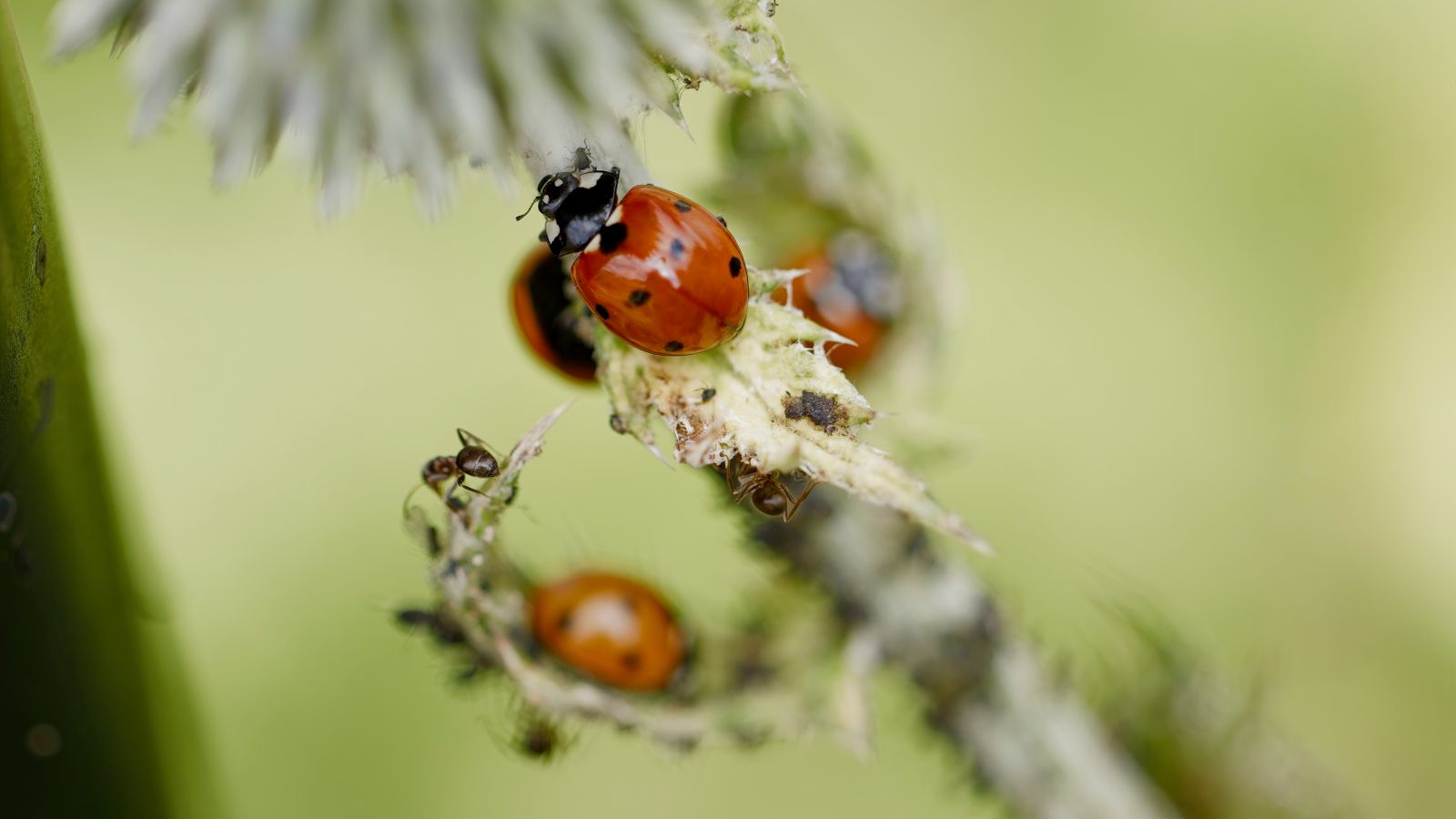
Detailed macro shot of ladybugs and ants on green stem with muted background.
Temperature and Humidity Windows Drive Pest Lifecycle Acceleration
Spider mite populations double every 5-7 days when daytime highs exceed 80°F and relative humidity drops below 50%, forcing cultivators to compress spray intervals from biweekly to every 4-5 days. Two-spotted spider mites (Tetranychus urticae) thrive in hot, dry microclimates on leaf undersides, with female mites laying up to 20 eggs per day at 85°F compared to 5 eggs per day at 65°F. Outdoor cultivators in California's Central Valley, southern Oregon, and Colorado's Front Range face the steepest pressure curves between mid-June and late August.
Powdery mildew spore germination rates peak when overnight temperatures stay above 68°F and morning dew persists past 9 a.m., conditions common across Pacific Northwest and Great Lakes regions. Fungal colonies can establish visible coverage within 72 hours of initial spore contact on susceptible cultivars like OG Kush and Gelato crosses.
Thrips populations surge in June as overwintering adults emerge and begin feeding on new vegetative growth, leaving characteristic silver stippling on fan leaves. Western flower thrips (Frankliniella occidentalis) complete a generation in 14 days at 77°F, enabling exponential population growth if left unchecked through early summer.
IPM Rotation Strategy: Alternate Modes of Action Every 7-10 Days
Effective summer pest management requires rotating at least three distinct modes of action to prevent resistance buildup, with foliar applications timed to target vulnerable life stages during early morning or late evening when stomata are open. Cultivators typically cycle between neem-based azadirachtin formulations (growth regulator), potassium bicarbonate solutions (contact fungicide), and Bacillus thuringiensis subspecies israelensis (biological larvicide) on 7-10 day intervals.
Azadirachtin disrupts insect molting and feeding behavior but requires direct contact with nymphs and adults. Miss the leaf undersides where mites colonize? Efficacy drops to near-zero. Apply at 0.5-1.0% concentration (5-10 mL per liter) with a non-ionic surfactant to improve leaf adhesion, then rotate off azadirachtin after three consecutive applications to avoid mite behavioral adaptation.
Potassium bicarbonate at 0.5-1.0% concentration raises leaf-surface pH above 8.0, creating an inhospitable environment for powdery mildew spores. Efficacy requires thorough coverage and reapplication every 5-7 days during high-pressure windows. For full background on integrated pest management frameworks, see the CannIntel topic hub on Cannabis Pest Management.
Late-Flower Constraints: Transition to OMRI-Listed Inputs by Week 4
Cultivators must transition away from oil-based sprays and synthetic miticides by week 4 of flower to avoid residue contamination and preserve terpene profiles, limiting late-season options to biological controls and environmental manipulation. Neem oil, insecticidal soaps, and horticultural oils leave residues that can fail state pesticide testing panels and impart off-flavors if applied after trichome development accelerates in mid-flower.
Predatory mites (Phytoseiulus persimilis, Neoseiulus californicus) offer non-residue biocontrol for spider mite outbreaks but require release rates of 5-10 predators per plant and take 10-14 days to establish hunting populations. Release predatory mites at dusk and maintain relative humidity above 60% to support predator survival. Efficacy drops sharply if daytime temperatures exceed 95°F for consecutive days.
Environmental controls become the primary tool in late flower: increasing airflow to 0.5-1.0 CFM per square foot of canopy, reducing overnight humidity below 55% with supplemental dehumidification, and pruning lower canopy to eliminate stagnant microclimates. These measures alone can suppress powdery mildew colonization by 60-70% compared to untreated controls, according to Oregon State University field trials conducted in 2024-2025.
Frequently asked questions
What temperature threshold accelerates spider mite reproduction in outdoor cannabis?
Spider mite populations double every 5-7 days when daytime temperatures exceed 80°F and relative humidity drops below 50%. At 85°F, female two-spotted spider mites lay up to 20 eggs per day compared to 5 eggs per day at 65°F, requiring cultivators to compress spray intervals from biweekly to every 4-5 days during peak summer heat.
When should cultivators stop using neem oil and insecticidal soaps on flowering cannabis?
Cultivators must discontinue oil-based sprays and synthetic miticides by week 4 of flower to avoid pesticide residue failures on state testing panels and to preserve terpene profiles. Neem oil and horticultural oils leave residues that can impart off-flavors if applied after trichome development accelerates in mid-flower.
How effective are predatory mites for late-season spider mite control?
Predatory mites (Phytoseiulus persimilis, Neoseiulus californicus) offer non-residue biocontrol at release rates of 5-10 predators per plant, but require 10-14 days to establish hunting populations and maintain efficacy only when daytime temperatures stay below 95°F and relative humidity exceeds 60%. Release at dusk for best survival rates.
What airflow rate suppresses powdery mildew in outdoor cannabis canopies?
Increasing airflow to 0.5-1.0 CFM per square foot of canopy, combined with overnight humidity below 55% and lower-canopy pruning, suppresses powdery mildew colonization by 60-70% compared to untreated controls, according to Oregon State University field trials. Environmental controls become the primary tool in late flower when foliar sprays are restricted.
Why must IPM protocols rotate modes of action every 7-10 days?
Rotating at least three distinct modes of action—such as azadirachtin (growth regulator), potassium bicarbonate (contact fungicide), and Bacillus thuringiensis (biological larvicide)—prevents resistance buildup in pest populations. Azadirachtin efficacy drops sharply after three consecutive applications as mites adapt feeding behavior, requiring rotation to alternative chemistries.
Sources
The cannabis newsletter you forward to your team.
Federal policy, market data, grower alerts, and the one story that matters today. Sent every weekday at 7am. Free.
No spam. Unsubscribe with one click. 21+ only.
Related from Grow

Cal-Mag in Cannabis: When You Need It and When It's Snake Oil
Most cal-mag problems are pH lockout or overwatering, not deficiency. Here's how to diagnose the real issue and stop wasting money on supplements.

Mycorrhizae in Cannabis: Which Species Work and Which Are Filler
Most root inoculants list 10+ fungal species. Only two matter for cannabis. Here's how to read labels and avoid paying for spores that won't colonize.

Tap vs RO vs Well Water: What's in Your Cannabis Irrigation
Municipal tap, reverse osmosis, and well water each carry dissolved minerals, chlorine, and contaminants that affect nutrient uptake and plant health.
More from the newsroom

Cannabis Club Data Breach Exposes One Million Passport Records
Unsecured database containing customer passport scans and transaction logs left accessible for weeks before discovery.

Bronx Dispensary Accused of Selling Unlicensed Cannabis Products
A Bronx cannabis retailer faces allegations of selling products without proper state authorization.

Maine Recalls Cannabis Flower Strain Sold at Multiple Stores Statewide
State regulators pulled a cannabis flower product from shelves across Maine following safety concerns.