Tissue Culture in Cannabis: Lab Process Replacing Mother Rooms
TC delivers disease-free clones at scale, but the sterile technique, contamination risk, and capital cost mean it's not for every operation.
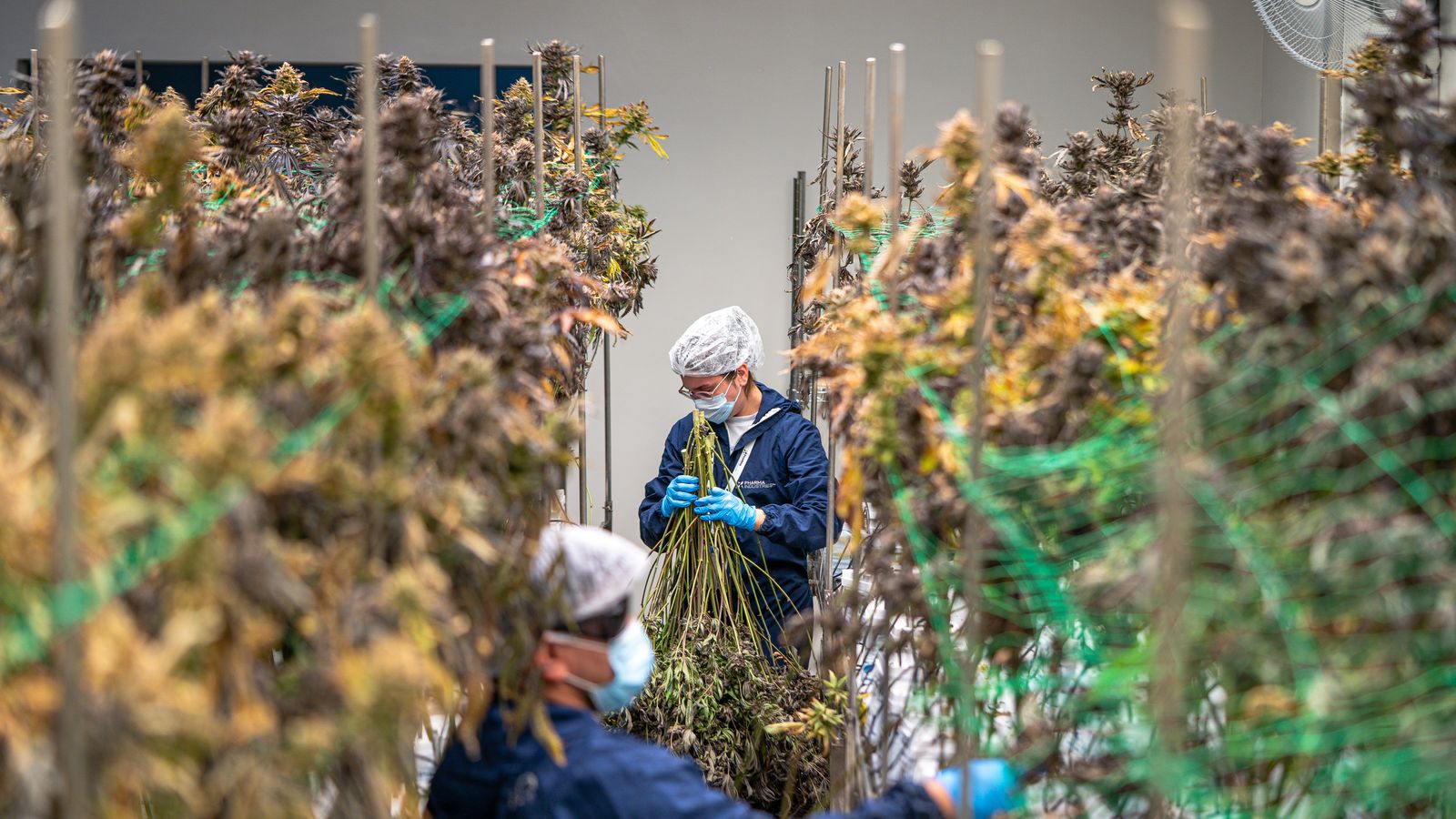
Workers in protective gear handling cannabis plants in an indoor facility.
A 10x10 mother room holding 40 plants under 600 watts of HPS can supply maybe 800 cuttings per month if you push it. A single tissue culture shelf the size of a bookcase can produce 10,000 plantlets in the same period, each one genetically identical and free of hop latent viroid, fusarium, and powdery mildew. The trade is labor intensity and contamination risk. One fungal spore in a jar wipes out 30 days of work. One tech who skips the flame sterilization step between cuts can contaminate an entire batch.
Tissue culture, also called micropropagation or TC, takes a small piece of plant tissue, surface sterilizes it with bleach or ethanol, and places it on nutrient agar in a sealed container under controlled light. The tissue generates shoots, which are divided and subcultured every four to six weeks. After several rounds of multiplication, plantlets are moved to rooting medium, then acclimatized to ambient humidity in a greenhouse. The result is a clone with no viral load, no insects, and no inherited stress from a mother plant that has been cut 200 times.
The appeal is obvious for breeders and large cultivators. You can store genetics in a lab freezer as cryopreserved nodal sections, ship plantlets across state lines in a padded envelope, and scale production without adding square footage to your veg room. But the process requires sterile technique, expensive media, and a tolerance for failure that most growers do not have. Contamination rates in new labs often run 20 to 30 percent until workflows tighten. Even experienced techs see 10 percent losses to fungal or bacterial contamination in routine production.
The Sterile Workflow
Tissue culture starts with explant selection. You need clean source material, which usually means taking a cutting from a healthy mother, surface sterilizing it, and isolating the apical meristem or a nodal segment under a laminar flow hood. The meristem is the actively dividing tissue at the growing tip, about 0.5 to 1 millimeter in size. It is largely free of systemic pathogens because viruses and bacteria do not move efficiently into rapidly dividing cells. Nodal explants, which include a small section of stem and axillary bud, are easier to handle and still produce clean cultures if the sterilization protocol is tight.
Surface sterilization typically involves a 70 percent ethanol dip for 30 seconds, followed by a 10 percent bleach solution for 10 to 15 minutes, then three rinses in sterile distilled water. The bleach kills surface fungi and bacteria without penetrating deep enough to damage the meristem. Timing matters. Too short and contamination rates spike. Too long and the tissue dies from chemical damage. Most labs run small trials with each new cultivar to dial in the protocol, because trichome density and cuticle thickness vary by strain.
Once sterilized, the explant is placed on initiation medium, a nutrient agar gel containing macronutrients, micronutrients, vitamins, sucrose, and plant growth regulators. The standard base is Murashige and Skoog medium, developed in 1962 and still the most widely used formulation. It provides nitrogen, phosphorus, potassium, calcium, magnesium, iron, and trace elements in concentrations optimized for cell division. Sucrose supplies carbon because the plantlets are not photosynthesizing efficiently yet. Agar, derived from seaweed, solidifies the medium so the tissue stays in place.
Growth regulators drive the process. Cytokinins like benzylaminopurine or kinetin promote shoot formation. Auxins like indole-3-butyric acid or naphthaleneacetic acid promote root formation. The ratio determines whether you get shoots, roots, or callus, an undifferentiated mass of cells. For shoot multiplication, you want high cytokinin and low auxin, typically 1 to 5 milligrams per liter of BAP and 0.1 to 0.5 milligrams per liter of IBA. For rooting, you flip the ratio.
Explants are cultured in sealed containers, usually glass jars or polycarbonate boxes, under 16 to 18 hours of light per day at 40 to 60 micromoles per square meter per second. Temperature is held at 22 to 25 degrees Celsius. Higher temps increase contamination risk. Lower temps slow growth. The containers are sealed to maintain humidity near 100 percent, which prevents desiccation but also creates ideal conditions for fungal growth if any spores make it past sterilization.
After three to four weeks, the explant produces multiple shoots. These are cut apart under the flow hood and transferred to fresh medium. Each shoot becomes a new explant, and the process repeats. A single explant can generate 10 to 20 shoots per cycle, and each of those can be divided again. The multiplication rate depends on the cultivar, the growth regulator concentration, and the subculture interval. Some strains double every cycle. Others produce only three or four shoots and need longer intervals to avoid decline.
Contamination and Loss Rates
Contamination is the primary failure mode. Fungi show up as fuzzy white, green, or black growth on the agar surface, usually within a week. Bacteria appear as slimy colonies or cloudy agar, sometimes with a foul smell. Either one spreads quickly in the sealed container and kills the plantlet. The contamination source is usually the explant itself, the tools, or the air in the flow hood.
Even with proper sterilization, endophytic bacteria and fungi live inside plant tissue and emerge during culture. These are not surface contaminants. They are systemic, and bleach does not reach them. The only solution is to start with cleaner source material or use antibiotics in the medium, which introduces its own problems. Antibiotics can inhibit plant growth, select for resistant strains, and create regulatory issues if residues persist into the final product.
Tool sterilization is straightforward but easy to skip under production pressure. Scalpels and forceps must be flamed between every cut, not just between plants. A single unsterilized cut transfers bacteria from one explant to the next, and by the time contamination is visible, the entire batch is compromised. Alcohol dips are not sufficient. The flame must heat the metal to red hot, then cool for five seconds before touching tissue. Most contamination events trace back to a tech who got rushed and skipped the flame step.
Flow hood discipline is the third variable. Laminar flow hoods push HEPA-filtered air across the work surface at 90 to 120 feet per minute, creating a sterile zone. But the zone only works if you do not block the airflow with your hands, keep the sash at the correct height, and avoid fast movements that create turbulence. Talking, coughing, or leaning over the work surface introduces contaminants. New techs often work too far forward or too far back, outside the sterile zone.
Experienced labs report contamination rates between 5 and 15 percent in routine production. New labs often see 30 percent or higher until workflows stabilize. The loss is not just the contaminated jar. It is the four weeks of shelf space, media, labor, and opportunity cost. At $2 per jar for media and containers, plus $15 per hour for tech time, a 20 percent contamination rate adds $1 to $2 per surviving plantlet in wasted inputs.
Acclimatization and Transplant Shock
Plantlets grown in vitro are soft, pale, and poorly adapted to ambient humidity. The leaves have thin cuticles, nonfunctional stomata, and limited root systems. Moving them directly from a sealed jar at 100 percent humidity to a greenhouse at 60 percent humidity kills them in hours. Acclimatization is a gradual process that takes two to four weeks and requires controlled conditions.
Most labs use a humidity dome or mist chamber to step down humidity in 10 percent increments every few days. Plantlets are removed from the jar, rinsed to remove agar, and planted in a sterile soilless mix or rockwool cube. They go into a chamber at 95 percent humidity under low light, 50 to 100 PPFD. After three days, humidity drops to 85 percent and light increases to 150 PPFD. After another three days, humidity drops again. The process continues until the plantlets tolerate 60 to 70 percent humidity and 300 to 400 PPFD, at which point they can move to standard propagation trays.
Survival rates during acclimatization range from 70 to 95 percent, depending on the cultivar and the protocol. Some strains adapt quickly. Others wilt and die even under careful management. The failure is usually desiccation, but fungal infection is also common because the plantlets have no immune priming and the high humidity favors pathogens. Growers used to traditional cloning often underestimate the labor and space required for acclimatization. A 10,000-plantlet batch needs 200 square feet of humidity chamber space and daily monitoring for two weeks.
Once acclimatized, TC plantlets grow like any other clone. They root in seven to ten days, veg normally, and flower on schedule. The main difference is uniformity. Because they come from meristem tissue, they have no accumulated mutations or epigenetic drift. A mother plant cut 500 times may show reduced vigor or altered cannabinoid ratios due to somatic mutations. TC plantlets reset to the original genotype. This matters for large cultivators running tight SOPs where a 2 percent shift in THC content or a three-day difference in flower time creates compliance or scheduling problems.
Economics and Scale
Tissue culture makes sense at two scales: very small and very large. A breeder with 50 cultivars and limited space can store genetics in a lab freezer and pull them out as needed, avoiding the cost and risk of maintaining 50 mother plants year-round. A 100,000-square-foot cultivation facility can produce clones at $0.50 to $1 each in-house, compared to $3 to $5 per clone from a nursery or $2 per clone from a traditional mother room when you factor in space, labor, and plant loss.
The middle ground is harder. A 10,000-square-foot facility producing 5,000 clones per month can run a mother room for $1,500 per month in overhead, including space, lights, labor, and nutrients. Setting up a tissue culture lab costs $30,000 to $50,000 for a flow hood, autoclave, growth chamber, and supplies, plus $3,000 to $5,000 per month in media, containers, and tech wages. The payback period is 18 to 24 months, assuming contamination rates stay below 15 percent and the facility does not already have excess veg space.
The cost per plantlet depends on throughput and contamination. At 10,000 plantlets per month with 10 percent contamination, direct costs run $0.80 to $1.20 per surviving plantlet, including media, containers, labor, and utilities. At 2,000 plantlets per month, costs rise to $2 to $3 per plantlet because fixed costs like the flow hood and autoclave are spread over fewer units. Traditional clones from a mother room cost $1.50 to $2.50 each when you include the mother plant space, but they carry pest and disease risk that TC eliminates.
The real value is not cost reduction. It is risk mitigation and genetic preservation. Hop latent viroid, which causes dudding and yield loss, spreads through vegetative propagation and persists in mother plants for years. A single infected mother can contaminate an entire facility. Tissue culture breaks the transmission cycle because the meristem is viroid-free. Labs that test explants with PCR before initiating culture can guarantee clean stock, which is worth the premium for cultivators who have lost crops to HLVd.
Genetic preservation is the other driver. Cannabis breeders work with hundreds of lines, many of which are not commercially viable but carry valuable traits for future crosses. Maintaining them all as mother plants is expensive and risky. A power outage, HVAC failure, or pest outbreak can wipe out years of work. Cryopreserved nodal sections stored in liquid nitrogen take up a few cubic feet and remain viable for decades. The storage cost is negligible compared to the value of the genetics.
Vendor Claims and Real Performance
The tissue culture equipment market is full of optimistic claims about ease of use and contamination rates. Vendors sell turnkey systems with pre-poured media, simplified protocols, and promises of 95 percent success rates. Real-world performance is lower. Most new labs see 60 to 70 percent success in the first six months, rising to 80 to 90 percent after a year of workflow refinement. The gap is not the equipment. It is the learning curve.
Sterile technique is a skill that takes months to develop. A tech who has never worked in a flow hood will contaminate jars no matter how good the protocol is. Training programs help, but there is no substitute for repetition. Labs that hire experienced tissue culture techs from other industries, like ornamental horticulture or pharmaceuticals, ramp up faster than those that train from scratch. The wage premium for experienced techs is $5 to $10 per hour, but the reduction in contamination and waste pays for itself in weeks.
Media formulations are another area where vendor claims diverge from reality. Pre-mixed media is convenient but expensive, often $3 to $5 per liter compared to $0.50 to $1 per liter for media mixed in-house. The quality is usually fine, but the cost adds up at scale. A lab producing 10,000 plantlets per month uses 200 to 300 liters of media, which is $600 to $1,500 per month for pre-mixed versus $100 to $300 for in-house. The trade is labor. Mixing media requires an autoclave, a scale, a pH meter, and a tech who understands the process. Mistakes in media prep, like incorrect pH or contaminated stock solutions, can kill entire batches.
Growth regulators are the most variable input. Different cultivars respond differently to the same cytokinin and auxin concentrations. A protocol that works for one strain may produce callus or no response in another. Most labs run small trials with each new cultivar, testing three or four growth regulator concentrations to find the optimal range. This takes time and media, but it is necessary. A protocol that produces five shoots per explant instead of ten doubles your labor and media cost per plantlet.
Disease Elimination and Testing
The primary argument for tissue culture is disease elimination, but the process is not foolproof. Meristem culture removes most viruses and viroids because these pathogens do not efficiently invade rapidly dividing cells. But some systemic bacteria and fungi persist even in meristem tissue. The only way to confirm clean stock is to test the plantlets with PCR or ELISA after several subculture cycles.
Hop latent viroid is the main target. HLVd causes stunted growth, reduced cannabinoid content, and brittle stems in infected plants, but symptoms are subtle and often mistaken for nutrient deficiency or environmental stress. The viroid spreads through contaminated tools, hands, and vegetative propagation. It does not spread through seed, so tissue culture combined with seed production is one way to break the cycle. But meristem culture alone does not guarantee elimination. Testing is required.
PCR testing costs $20 to $50 per sample and takes two to five days for results. Labs that produce clean stock test every explant batch before releasing plantlets to production. This adds cost but eliminates the risk of introducing HLVd into a clean facility. Some labs also test for fusarium, pythium, and bacterial pathogens, though these are less common in meristem tissue and usually show up as contamination during culture rather than as systemic infection.
The testing requirement adds a quality control step that traditional cloning does not have. A mother room can harbor HLVd for months before symptoms appear, and by then the entire clone inventory is infected. Tissue culture forces the testing decision up front, which increases costs but reduces long-term risk. For large facilities where a single HLVd outbreak can cost $500,000 in lost yield, the testing cost is negligible.
Cryopreservation and Long-Term Storage
Cryopreservation stores plant tissue in liquid nitrogen at -196 degrees Celsius, halting all metabolic activity. Nodal sections or shoot tips are treated with a cryoprotectant solution, usually DMSO or glycerol, then frozen in a controlled-rate freezer or plunged directly into nitrogen. The tissue remains viable for decades, possibly indefinitely. When needed, it is thawed, rinsed, and placed on recovery medium. Survival rates range from 40 to 80 percent, depending on the cultivar and the protocol.
The advantage is space and security. A single cryovial holds enough tissue to regenerate thousands of plants and takes up less space than a test tube. A breeder with 500 lines can store the entire collection in a small dewar, a vacuum-insulated container that holds liquid nitrogen. The nitrogen boils off slowly and must be refilled every few weeks, but the cost is minimal compared to maintaining 500 mother plants.
Cryopreservation is not simple. The freezing and thawing process creates ice crystals that puncture cell membranes, killing the tissue. Cryoprotectants reduce ice formation, but they are also toxic at high concentrations. The protocol requires precise timing, temperature control, and recovery conditions. Most labs send samples to specialized cryopreservation services rather than attempting it in-house. The cost is $50 to $200 per line for initial cryopreservation, plus $10 to $20 per year for storage.
The real value is insurance. A fire, flood, or regulatory seizure can destroy a mother room in hours. Cryopreserved backups stored off-site provide recovery options. Some breeders keep duplicate collections in different states or countries to hedge against regulatory risk. The cost is low compared to the value of proprietary genetics that took years to develop.
Common Mistakes and How to Avoid Them
New tissue culture labs make predictable mistakes. The first is underestimating contamination. A 10 percent contamination rate sounds manageable until you realize it means one in ten jars is a total loss, and contamination often clusters in batches due to a single workflow error. Planning for 20 percent contamination in the first year and 10 percent thereafter keeps expectations realistic and budgets intact.
The second mistake is inadequate training. Tissue culture is not intuitive. A grower who has run a mother room for ten years will still contaminate jars if they have never worked in a flow hood. Sending techs to a hands-on training course or hiring an experienced consultant for the first few months reduces the learning curve and prevents expensive mistakes. The cost is $2,000 to $5,000, but it saves $10,000 to $20,000 in wasted media and lost production.
The third mistake is poor record keeping. Tissue culture involves multiple subculture cycles, and it is easy to lose track of which jar came from which explant or how many times a line has been subcultured. Over-subculturing leads to genetic drift and reduced vigor. Most labs use a database or spreadsheet to track each line, recording the subculture date, growth regulator concentration, contamination rate, and any observations. This takes discipline but prevents costly errors like releasing plantlets from a contaminated or over-subcultured line.
The fourth mistake is skipping acclimatization. Plantlets look healthy in the jar, and it is tempting to transplant them directly into propagation trays to save time. Survival rates drop to 30 percent or lower. The two-week acclimatization process is not optional. It is the difference between 90 percent survival and 30 percent survival, and the labor cost is trivial compared to the value of the plantlets.
The fifth mistake is ignoring cultivar-specific responses. A protocol that works for one strain may fail for another. Growth regulator concentrations, sterilization times, and subculture intervals all vary by genetics. Labs that treat every cultivar the same waste time and media. Running small trials with each new line and documenting the results builds a protocol library that improves efficiency over time.
When Tissue Culture Makes Sense
Tissue culture is not a universal solution. It makes sense for breeders who need to store and distribute genetics, for large cultivators who need disease-free clones at scale, and for facilities with limited space or high pest pressure. It does not make sense for small growers who produce a few hundred clones per month, have excess veg space, and already run clean mother rooms. The capital cost and learning curve are too high for marginal gains.
The decision depends on clone volume, contamination risk, and space cost. A facility producing 10,000 clones per month in a high-rent market where veg space costs $50 per square foot per year can justify the investment. A facility producing 2,000 clones per month in a low-rent market with cheap veg space cannot. The payback period stretches to three or four years, and by then the equipment may need replacement or the facility may have shifted to seed production.
Pest and disease pressure tips the scale. A facility with recurring HLVd, broad mites, or russet mites may find that tissue culture pays for itself in a single crop by eliminating reinfection from the mother room. A clean facility with tight IPM and no disease history gets less value from TC. The risk mitigation is worth something, but it is harder to quantify.
Genetic preservation is the wildcard. For breeders and seed companies, the ability to store hundreds of lines in a small freezer and distribute clean plantlets on demand is worth the investment regardless of clone production volume. The alternative is maintaining a large mother room year-round, which ties up space, labor, and capital. Tissue culture shifts the cost structure from ongoing overhead to upfront capital and per-unit production cost, which aligns better with project-based breeding work.
Frequently asked questions
What contamination rate should I expect in the first year of tissue culture production?
New labs typically see 20 to 30 percent contamination until workflows stabilize, dropping to 10 to 15 percent with experience. Experienced techs and strict sterile protocols reduce losses, but even mature labs lose 5 to 10 percent of jars to fungal or bacterial contamination.
How much does it cost to set up a tissue culture lab for cannabis?
Expect $30,000 to $50,000 for a laminar flow hood, autoclave, growth chamber, and initial supplies. Monthly operating costs run $3,000 to $5,000 for media, containers, and tech wages, with per-plantlet costs of $0.80 to $1.20 at high volumes.
Can tissue culture eliminate hop latent viroid from infected plants?
Meristem culture removes most viroids because they do not efficiently invade rapidly dividing cells, but PCR testing is required to confirm elimination. Some systemic pathogens persist even in meristem tissue, so testing every explant batch before releasing plantlets is necessary.
How long does acclimatization take and what survival rates are typical?
Acclimatization takes two to four weeks, stepping humidity down from 95 percent to 60 percent in 10 percent increments. Survival rates range from 70 to 95 percent depending on the cultivar and protocol, with desiccation and fungal infection being the primary failure modes.
What is the shelf life of cryopreserved cannabis tissue?
Tissue stored in liquid nitrogen at -196 degrees Celsius remains viable for decades, possibly indefinitely. Survival rates after thawing range from 40 to 80 percent depending on the cultivar and cryoprotectant protocol, providing long-term genetic insurance.
Do all cannabis strains respond the same way to tissue culture protocols?
No. Growth regulator concentrations, sterilization times, and subculture intervals vary by genetics. Labs must run small trials with each new cultivar to optimize the protocol, as a formulation that works for one strain may produce callus or no response in another.
At what production volume does tissue culture become cost-effective compared to mother rooms?
Tissue culture makes economic sense above 10,000 clones per month or for breeders storing many genetics in limited space. Below 5,000 clones per month, the capital cost and learning curve often exceed the savings unless disease pressure or space constraints justify the investment.
What are the most common mistakes new tissue culture labs make?
Underestimating contamination rates, inadequate tech training, poor record keeping, skipping acclimatization, and using the same protocol for all cultivars. These mistakes lead to high losses, wasted media, and failed batches that extend the payback period and frustrate operators.
Sources
The cannabis newsletter you forward to your team.
Federal policy, market data, grower alerts, and the one story that matters today. Sent every weekday at 7am. Free.
No spam. Unsubscribe with one click. 21+ only.
Related from Grow

Living Soil Cannabis: The No-Till System That Gets Better Year Over Year
No-till living soil builds microbial density and nutrient cycling that bottled feeds can't match. Here's how to set up, maintain, and scale the system.

Fusarium and Root Rot in Hydro: Economics of the Silent Kill
Fusarium and pythium cost commercial growers 15-40% yield before symptoms show. Here's how to identify, prevent, and recover from hydroponic root disease.

Spider Mites in Cannabis: The Eradication Protocol That Works
Commercial growers lose 15-30% of crop value to spider mites annually. Here's the integrated eradication protocol that stops them without torching your schedule.
More from the newsroom

Virginia Governor Veto Blocks Retail Marijuana Sales Launch
Governor Glenn Youngkin's veto of HB 2314 halts the planned July 1 start of adult-use cannabis sales, leaving licensed operators in limbo.
Taiwan Proposes Revoking Licenses for Marijuana Use Abroad
New draft regulation would strip professional and driver licenses from Taiwanese nationals who consume cannabis in jurisdictions where it's legal.

NSW Sets THC Driving Limit for Medical Cannabis Patients
New South Wales introduces impairment-based THC threshold, ending zero-tolerance policy for prescribed patients.