Powdery Mildew on Cannabis: Prevention Beats Every Treatment
PM spreads faster than any spray can stop it. Commercial growers who wait for symptoms lose entire rooms. Here's the environmental and operational protocol that works.
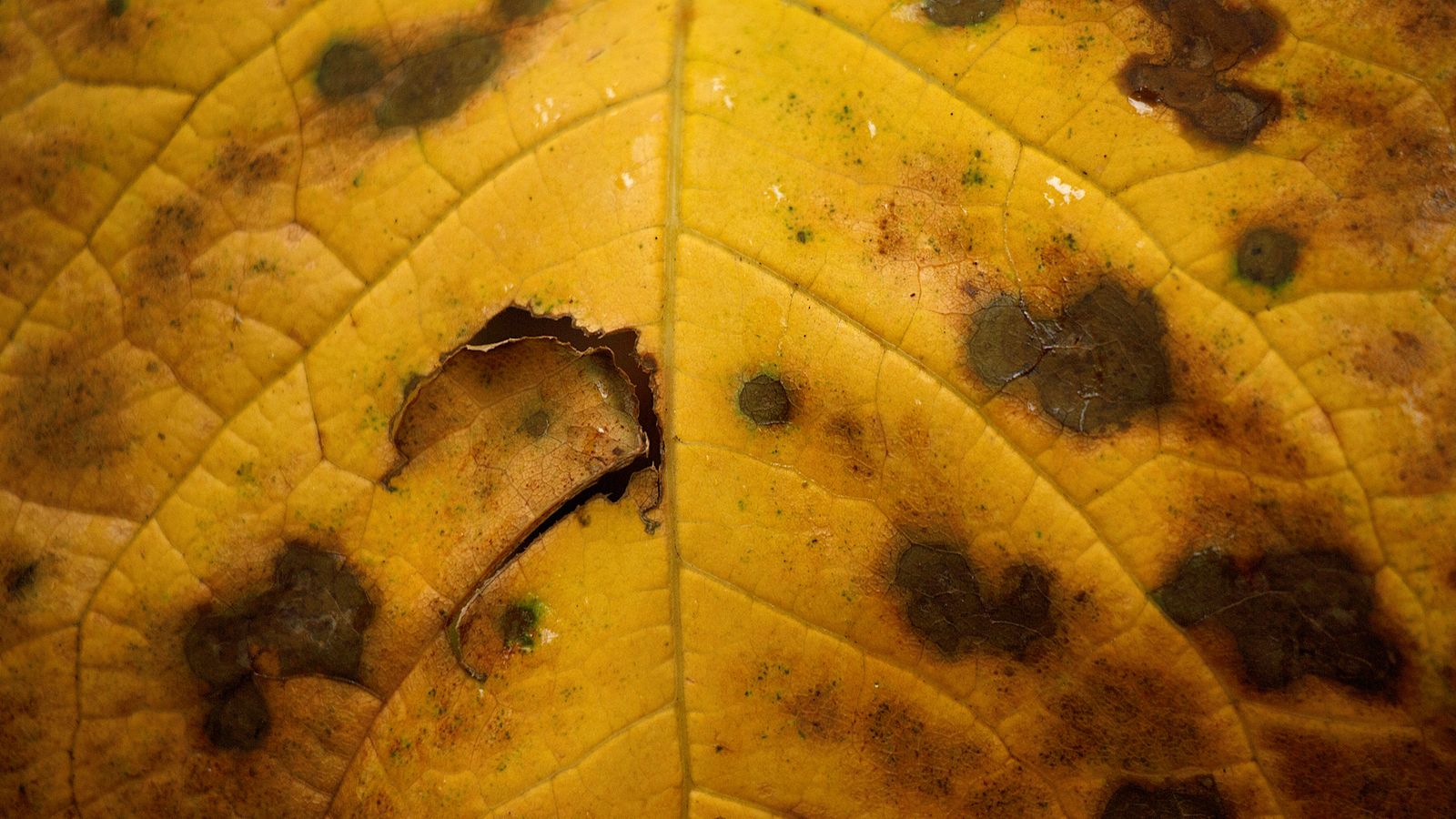
Macro photograph of a yellow leaf with dark spots revealing decay or infection.
Powdery mildew is the single most common fungal pathogen in commercial cannabis cultivation, and it costs the industry more in lost product than any other disease. Unlike botrytis, which needs wet surfaces, PM thrives in the exact conditions many growers create by accident: moderate humidity, poor airflow, and dense canopies. A single infected clone can seed an entire facility in two weeks. The white powdery coating you see on leaves is the fruiting body of the fungus, releasing thousands of spores per square inch every day. By the time it's visible, you're already behind.
The economic damage is straightforward. Light PM infections reduce photosynthetic capacity and slow growth. Moderate infections make flower unsellable in any regulated market, testing labs reject it, and even if it passes microbial limits, dispensaries won't stock product with visible PM. Heavy infections mean total crop loss. A 10,000-square-foot flower room turning four times per year at 40 grams per square foot wholesale is a $1.6 million annual revenue stream. One PM outbreak that forces an early harvest or a total cull erases a quarter million dollars in a single cycle, plus the cost of remediation and the next cycle's delay.
Most growers who lose rooms to PM made the same mistake: they saw early symptoms, sprayed something, and assumed the problem was handled. It wasn't. PM is an obligate biotroph, meaning it only grows on living tissue, and it's extremely good at surviving environmental stress. Spores can remain viable for weeks in low humidity, then germinate within hours when conditions improve. The fungus grows both on the leaf surface and sends haustoria into plant cells to extract nutrients, which makes it nearly impossible to kill without damaging the plant. Every commercial treatment, whether chemical or biological, works by preventing new infections or slowing existing ones. None of them cure an established infection.
Why Powdery Mildew Loves Cannabis Facilities
PM spreads through airborne spores, and cannabis grow rooms are ideal dispersal chambers. Oscillating fans, HVAC returns, and foot traffic move spores from plant to plant faster than the fungus could ever spread on its own. The pathogen doesn't need water on leaf surfaces to germinate, just humidity above 50% and temperatures between 60-80°F. That's the exact range most growers target during flower. Add in dense canopies where leaves touch, and you've built a PM incubator.
The fungus is host-specific. The PM that infects cannabis is primarily Golovinomyces cichoracearum and Podosphaera macularis, though recent genetic work suggests the taxonomy is still being sorted out. It doesn't matter for operational purposes. What matters is that it spreads faster in flower than in veg, it prefers certain cultivars over others, and it loves the microenvironments created by poor airflow. If you're running a sea of green with plants touching at week three of flower, you're asking for it.
Cultivar susceptibility is real but inconsistent. Some lines, particularly older Afghani genetics and certain Cookies crosses, seem more prone to infection. Other cultivars can sit next to infected plants and stay clean. The mechanism isn't well understood, possibly related to leaf surface structure or secondary metabolite production, but it's not reliable enough to breed your way out of the problem. Even resistant cultivars will get PM if environmental conditions are bad enough.
The Myth of Effective Treatments
Walk into any hydro shop and you'll find a dozen products claiming to eliminate PM. Sulfur burners, potassium bicarbonate sprays, neem oil, biological fungicides with Bacillus or Trichoderma strains, essential oil blends, and a rotating cast of new formulations with aggressive marketing. Some of them work as preventatives. None of them work reliably as cures once PM is established, and several create new problems.
Sulfur is the oldest tool in the book. Vaporized sulfur or wettable sulfur sprays kill PM spores on contact and provide some residual protection. The problem is timing and phytotoxicity. Sulfur can't be used within two weeks of any oil-based spray or you risk burning the plants. It can't be used during flower in most markets because residue limits are strict and sulfur affects flavor. It works best as a preventative in veg, but even then, you're just suppressing the fungus, not eliminating it. If you stop treatments, PM comes back.
Potassium bicarbonate raises the pH on leaf surfaces, which inhibits spore germination. It's one of the few treatments allowed in organic certification programs, and it's relatively safe. It also washes off with the next watering or rain, provides no systemic protection, and does nothing to existing infections. You're spraying every three to five days to maintain coverage, which means labor costs add up and you're still just managing the problem, not solving it.
Biological fungicides are popular because they sound clean and they're allowed late into flower in some jurisdictions. Products containing Bacillus subtilis or Bacillus amyloliquefaciens work by colonizing leaf surfaces and outcompeting PM for space and nutrients. In trials, they reduce PM severity by 30-60% compared to untreated controls. That's not good enough. A 50% reduction in a moderate infection still leaves you with unsellable flower. Biologicals work best as preventatives, applied weekly starting in early veg, but they require consistent reapplication and they don't survive long under high-intensity light or low humidity.
The bigger issue with any spray program is coverage. PM grows on the underside of leaves, in the crotches of branches, and deep in the canopy where spray penetration is poor. Even with good technique, you're leaving refugia where the fungus survives and recolonizes. In a packed flower room, you can't get a spray wand into the middle of the canopy without damaging plants. By week five of flower, it's nearly impossible to achieve the coverage you'd need to knock down an established infection.
Some growers try hydrogen peroxide, ozone, or UV light. Hydrogen peroxide at high concentrations will kill PM on contact, but it also burns leaves and breaks down rapidly. Ozone generators can reduce airborne spore counts, but ozone is phytotoxic at the concentrations needed to be effective, and it doesn't kill the fungus already growing on plants. UV-C light kills spores, but it requires direct line-of-sight exposure and it degrades cannabinoids and terpenes if used during flower. None of these are practical solutions in a production environment.
Environmental Control as the Primary Defense
The only strategy that works consistently is keeping environmental conditions outside the range where PM can establish. That means humidity control, airflow, and canopy management. It's not complicated, but it requires discipline and equipment that many mid-tier grows skip to save on capital costs. That's a mistake. The cost of a proper dehumidification system is a fraction of the cost of a single lost crop.
Humidity is the most important variable. PM spores germinate poorly below 50% relative humidity, and the fungus struggles to grow below 45%. Most growers run 55-65% RH during flower to avoid over-drying, but that's right in the sweet spot for PM. The trade-off is real: lower humidity increases VPD, which can stress plants and reduce growth rates if you're not managing it with temperature and irrigation. But a room at 45% RH with proper VPD management will stay PM-free, while a room at 60% RH with poor airflow will get infected eventually.
The practical target is 45-50% RH during flower, adjusted based on temperature to keep VPD in the 1.0-1.4 kPa range. That requires serious dehumidification capacity. A 5,000-square-foot flower room with 1,000 plants transpiring at full speed can dump 200-300 gallons of water into the air per day. Your HVAC system needs to pull that moisture out faster than the plants add it, which means oversizing your dehumidification by 20-30% beyond the calculated load. Undersized systems run continuously, fail to hit setpoints, and create the exact conditions PM loves.
Airflow is the second critical factor. Stagnant air creates microclimates where humidity spikes and PM thrives. Every plant needs moving air on all sides, not just the tops. That means oscillating fans at multiple heights, not just a few fans blowing across the canopy. A common rule is one 16-inch oscillating fan per 100 square feet of canopy, but that's a minimum. In dense grows, you need more. The goal is gentle, constant movement that prevents moisture from accumulating on leaf surfaces without causing wind burn.
HVAC design matters more than most growers realize. A well-designed system creates even air distribution with no dead zones. A poorly designed system creates hot spots, cold spots, and pockets of stagnant air where PM colonizes first. Computational fluid dynamics modeling is overkill for most operations, but basic principles apply: supply air should enter high and distribute across the canopy, return air should pull from low to create circulation, and the system should turn over the room volume at least once per minute. Undersized or poorly placed ducting creates the dead zones where PM starts.
Canopy Management and Plant Spacing
Dense canopies are PM incubators. Leaves touching leaves create high-humidity microclimates and block airflow. The solution is aggressive defoliation and proper plant spacing. This is where many growers resist, because removing leaves feels like removing yield. In reality, a clean canopy with good airflow will outyield a dense, infected canopy every time.
Defoliation should happen at least twice during flower: once at the flip to 12/12, removing all fan leaves that block bud sites or touch neighboring plants, and again at week three, removing any new growth that's crowding the canopy. Some cultivars need a third pass at week five. The goal is to open the canopy enough that you can see through it and air can move freely. If you can't see the soil or the floor of the trellis, you haven't removed enough.
Plant spacing is just as important. A common mistake is packing plants too tight to maximize canopy coverage and yield per square foot. That works in the first few weeks, but by mid-flower, the canopy is so dense that airflow stops and humidity spikes. A better approach is to space plants far enough apart that they don't touch at peak flower, even if it means slightly lower plant counts. The yield per plant increases enough to offset the lower density, and the PM risk drops dramatically.
Trellis systems help, but only if you use them correctly. A single-layer trellis at 8-12 inches above the pot keeps the canopy flat and improves light penetration, but it doesn't solve airflow problems if the canopy is still too dense. A double-layer trellis with the second layer at 18-24 inches allows you to spread the canopy vertically, which improves airflow and light distribution. The trade-off is more labor during setup and harvest, but it's worth it in high-risk environments.
Intake Air and Facility Hygiene
PM spores are everywhere. They're in the air outside, they're on your clothes, they're on incoming clones, and they're in the dust on your floors. You can't eliminate them entirely, but you can reduce the spore load enough that your environmental controls keep the fungus from establishing. That means filtration, sanitation, and strict protocols around plant movement.
Intake air should be filtered to MERV 13 or higher. MERV 8 filters, which are standard in most HVAC systems, catch large particulates but let PM spores through. MERV 13 filters catch particles down to 0.3 microns, which includes most fungal spores. The trade-off is higher static pressure and more frequent filter changes, but the cost is negligible compared to the cost of an outbreak. Some high-end facilities use HEPA filtration, which is overkill for most operations but provides an extra margin of safety.
Sanitation between cycles is non-negotiable. Every surface in the grow room should be cleaned with a broad-spectrum disinfectant after harvest. Hydrogen peroxide at 3-10%, quaternary ammonium compounds, or chlorine dioxide all work. The goal is to kill any spores that settled on walls, floors, lights, and equipment during the previous cycle. Skipping this step is how PM becomes endemic in a facility. One infected cycle seeds the room, and every subsequent cycle starts with a higher spore load.
Incoming clones are the most common vector for introducing PM into a clean facility. Every clone should be quarantined for at least one week, ideally two, in a separate room with independent HVAC. Inspect them daily for any signs of PM, and if you see it, cull the entire batch. The cost of replacing a batch of clones is trivial compared to the cost of seeding your entire facility. Some growers treat all incoming clones with a preventative spray, which reduces risk but doesn't eliminate it.
Foot traffic is another vector. Spores stick to clothing, shoes, and skin. A clean facility requires a gowning protocol: dedicated grow room clothing, shoe covers or dedicated shoes, and hand washing before entering. It sounds excessive, but it's standard practice in any high-value horticulture operation, and cannabis is no different. The more people moving between rooms, the higher the risk of cross-contamination.
Monitoring and Early Detection
The best prevention program in the world won't catch every infection, so early detection is critical. PM is easier to manage when it's limited to a few plants than when it's spread across the room. That means daily scouting, not weekly walk-throughs. Someone should be in the flower rooms every day, looking at the undersides of leaves, checking dense areas of the canopy, and watching for the first signs of infection.
Early PM looks like small white spots on the underside of fan leaves, usually starting in the lower canopy where airflow is worst. It's easy to miss if you're not looking for it. By the time it's visible on the tops of leaves or spreading to buds, you're already in trouble. A 10x hand lens helps, but most experienced growers can spot early PM with the naked eye once they know what to look for.
If you catch it early, the response is immediate and aggressive. Remove the infected plant and any plants within two feet of it. Bag them before moving them out of the room to avoid spreading spores. Increase airflow in the affected area, drop humidity by 5%, and increase scouting frequency to twice per day. If you see new infections within 48 hours, you're dealing with a larger problem and you need to consider whether the room is salvageable.
Some growers use spore traps or air sampling to monitor PM levels before symptoms appear. This is more common in large commercial operations where the cost of monitoring is justified by the value of the crop. Spore traps are passive devices that collect airborne spores on a sticky surface, which you then send to a lab for identification and quantification. Air sampling uses a pump to pull a known volume of air through a filter, which is also sent to a lab. Both methods give you a baseline spore count and let you track whether your prevention program is working. If spore counts start climbing, you know you have a problem before you see symptoms.
The Role of Genetics and Integrated Strategies
Some cultivars are more resistant to PM than others, and selecting for resistance is a long-term strategy worth pursuing. The problem is that resistance is polygenic and not well understood, so you can't just breed for it the way you'd breed for THC content. What you can do is track which cultivars in your facility get PM first and which stay clean, then adjust your strain menu accordingly. If a particular cut is consistently the first to show symptoms, it's a liability, and you should consider dropping it regardless of its other qualities.
Integrated pest management principles apply to PM even though it's not a pest. The idea is to use multiple strategies in combination, so that if one fails, the others provide backup. Environmental control is the foundation, but you layer on sanitation, monitoring, and selective use of preventative treatments. A facility that runs 45% RH, has excellent airflow, filters intake air, sanitizes between cycles, scouts daily, and applies a biological fungicide weekly in veg is far less likely to have a PM problem than a facility that relies on any single strategy.
The cost of this approach is higher upfront but lower over time. A proper dehumidification system, MERV 13 filters, and a gowning protocol require capital investment and ongoing labor. But the cost of a single PM outbreak, including lost product, remediation, and delayed cycles, is almost always higher than the cost of prevention. The math is straightforward: a $50,000 investment in environmental controls protects a $1.6 million annual revenue stream. The ROI is obvious.
What to Do When Prevention Fails
Even with perfect environmental control, PM can still show up. A single infected clone, a brief HVAC failure, or an unusually humid week can seed an infection. When that happens, the question is whether to treat or cull. The answer depends on timing, severity, and the value of the crop.
If you're in early veg and you catch PM on a few plants, cull them and move on. The cost of replacing veg plants is low, and the risk of spreading the infection is high. If you're in late flower and you see light PM on a few lower fan leaves, you might get away with removing the affected leaves, increasing airflow, and pushing through to harvest. If you're in mid-flower and you see moderate PM spreading across multiple plants, you're in a tough spot. Treatments won't save the crop, and the infection will likely worsen before harvest.
Some growers try to salvage infected flower by washing it post-harvest. Bud washing involves dunking harvested branches in a series of water baths, sometimes with hydrogen peroxide or lemon juice and baking soda added to the first bath. The idea is to rinse off PM spores and residues. It works to some extent, removing surface contamination, but it doesn't remove PM that's grown into the bud structure, and it doesn't address the fact that the flower is already compromised. Washed flower often fails microbial testing anyway, and even if it passes, it's lower quality. It's a last resort, not a solution.
The hard truth is that once PM is established in a flower room, your options are bad. You can try to limp through to harvest and hope the infection doesn't worsen, knowing you'll likely have to sell the flower at a steep discount or send it to extraction. You can harvest early, accepting lower cannabinoid content and reduced yield. Or you can cull the entire room, take the loss, and start clean. The right choice depends on the numbers, but in most cases, cutting your losses and starting over is the least-bad option.
Long-Term Facility Management
PM is a chronic problem, not an acute one. A facility that has PM once will have it again unless the underlying conditions change. That means prevention isn't a one-time project, it's an ongoing operational discipline. Environmental setpoints need to be monitored and maintained every day. Filters need to be changed on schedule. Sanitation protocols need to be followed every cycle. Scouting needs to happen every day, not just when someone has time.
The facilities that stay PM-free are the ones that treat it as a systems problem, not a product problem. They invest in the infrastructure to control humidity and airflow. They train staff on scouting and sanitation. They track data on environmental conditions, spore counts, and infection rates, and they adjust protocols based on what the data shows. They don't rely on sprays or hope. They rely on discipline and systems.
For smaller operations, the same principles apply but the execution is different. You might not have the budget for a $50,000 dehumidification system, but you can run smaller dehumidifiers, add more fans, space plants farther apart, and defoliate more aggressively. You can filter your intake air with a box fan and a MERV 13 filter. You can sanitize between cycles with a $20 bottle of hydrogen peroxide. The scale is different, but the logic is the same: create conditions where PM can't thrive, and you won't have to fight it.
Frequently asked questions
Can I use sulfur burners during flower to treat powdery mildew?
Sulfur burners work as preventatives but can't be used within two weeks of harvest in most regulated markets due to residue limits and flavor impacts. They also can't be combined with oil-based sprays without risking phytotoxicity. Use sulfur in veg only.
What humidity level prevents powdery mildew without stressing plants?
Target 45-50% relative humidity during flower, adjusted with temperature to maintain VPD between 1.0-1.4 kPa. PM struggles to establish below 50% RH, while plants tolerate these conditions with proper irrigation and temperature management.
How much defoliation is necessary to prevent PM in dense canopies?
Remove all fan leaves that block bud sites or touch neighboring plants at flip to 12/12, then repeat at week three of flower. The canopy should be open enough to see through, allowing airflow to reach all plant surfaces without obstruction.
Do biological fungicides like Bacillus subtilis actually work against PM?
Biological fungicides reduce PM severity by 30-60% in trials when applied weekly as preventatives starting in veg. They don't cure established infections and require consistent reapplication, but they're among the safer options for late-stage flower in some jurisdictions.
Should I cull an entire room if I find powdery mildew in week five of flower?
It depends on severity and spread. Light PM on a few lower leaves might be manageable by removing affected plants and increasing airflow. Moderate PM across multiple plants will likely worsen before harvest, making early harvest or culling the better economic choice than trying to treat through to finish.
Can I breed cannabis cultivars that are resistant to powdery mildew?
Some cultivars show more resistance than others, but PM resistance is polygenic and not well understood. Track which strains in your facility get infected first and adjust your strain menu accordingly, but don't rely on genetics alone as a prevention strategy.
How often should I change HVAC filters to prevent PM spores from entering my grow?
Use MERV 13 or higher filters and change them according to manufacturer recommendations, typically every 3-6 months depending on dust load. Monitor static pressure across filters, and change them sooner if pressure drops or airflow decreases.
Does bud washing remove powdery mildew from harvested flower?
Bud washing removes surface spores and some residues but doesn't eliminate PM that has grown into bud structure. Washed flower often still fails microbial testing and is lower quality. It's a last resort for salvaging compromised product, not a reliable solution.
Sources
The cannabis newsletter you forward to your team.
Federal policy, market data, grower alerts, and the one story that matters today. Sent every weekday at 7am. Free.
No spam. Unsubscribe with one click. 21+ only.
Related from Grow
Russet Mites in Cannabis: Spotting Damage Before It Shows
Russet mites destroy crops before most growers see them. Learn the early signs, microscopy protocols, and IPM strategies that actually work at scale.

The VPD cheat sheet every indoor cannabis grower needs
Vapor pressure deficit controls transpiration, nutrient uptake, and pathogen risk. Here are the numbers that matter, stage by stage, with the context to use them.

Outdoor Cannabis Soil Prep: Amend the Holes, Not the Transplants
Most outdoor growers waste money amending transplant soil. The real work happens in the native hole — six weeks before you plant.
More from the newsroom

Black Cannabis Owner Details Capital Access Barriers in Social Equity
Exclusive interview reveals financing gaps and regulatory costs still blocking social-equity licensees in legal markets.

TSA Clarifies Medical Marijuana Air Travel Rules Amid State-Federal Gaps
Federal screening policy permits medical cannabis in carry-on bags, but passengers face arrest risk in states without legal protections.

Artist Susan Barron Unveils Veteran PTSD Portrait Series
Mixed-media project pairs veteran faces with cannabis-therapy narratives to destigmatize post-service mental health treatment.